
MOTIV™ TKA Circle Encouraging Emerging Trends
October 29, 2026


MOTIV™ TKA Circle Encouraging Emerging Trends
Executive Summary & Clinical Rationale
As value-based reimbursement models mature, the Centers for Medicare & Medicaid Services (CMS) has codified longitudinal functional tracking directly into hospital payment determinations through the Hospital-Level Patient-Reported Outcome-Based Performance Measure (PRO-PM) for Primary Total Hip and Total Knee Arthroplasty (THA/TKA). Under the CMS Inpatient Quality Reporting (IQR) framework, surgical practices and health systems face dual operational challenges.
First, institutions must secure paired pre- and postoperative PROM collections across at least 50% of eligible cases to avert a statutory 25% reduction in their annual Medicare Annual Payment Update (APU) market basket percentage increase.¹˒² Second, facilities must meet risk-standardized improvement thresholds that evaluate whether individual patients achieve a Substantial Clinical Benefit (SCB), defined nationally as a 20-point or greater improvement on the Knee injury and Osteoarthritis Outcome Score for Joint Replacement (KOOS JR).³
These quality mandates carry heightened urgency under the finalized Comprehensive Care for Joint Replacement Expanded (CJR-X) model, taking effect nationwide on January 1, 2028 across approximately 2,500 acute care hospitals. Under CJR-X, CMS transitions standard facilities into localized risk-bearing payers, mandating two-sided actuarial accountability across a 90-day cross-continuum episode encompassing inpatient surgery, professional fees, and post-acute utilization.
Crucially, the model weaponizes the Composite Quality Score (CQS) as an absolute financial gatekeeper: failing to meet required PROM survey capture thresholds or clinical improvement targets forfeits a hospital’s entire reconciliation payment, transferring all downside financial liability directly onto the institution’s balance sheet regardless of realized procedural savings.⁸˒⁹
Historically, large-scale national registries (such as the American Joint Replacement Registry) have aligned PROM collection almost exclusively with CMS reporting windows, capturing outcomes preoperatively and between 10 and 14 months (300–425 days) postoperatively.¹˒² While this timeline evaluates final arthroplasty end-states, it leaves early functional recovery—specifically the acute 2-week, 6-week, and 3-month intervals—largely uncharacterized in multi-center datasets. Furthermore, relying entirely on a 1-year survey window introduces substantial patient attrition, as recovered patients routinely disengage from clinical follow-up.¹˒⁷
The MOTIV™ Wickline/Mercuri TKA Circle—a product-agnostic, real-world evidence (RWE) initiative established in collaboration with the Orthopaedic Research and Education Foundation (OREF) and co-designed by Drs. Andrew Wickline and John Mercuri—addresses these longitudinal limitations.⁴ By pairing standardized clinical pathways with automated, direct-to-patient digital workflows, MOTIV™ captures high-frequency functional recovery across 2 weeks, 6 weeks, 3 months, 6 months, and 1 year postoperatively while sustaining exceptionally high cohort adherence. This briefing evaluates interim KOOS JR trajectories and compliance benchmarks from the actively enrolling MOTIV™ cohort against landmark validation literature and multi-center registry standards.
MOTIV™ Interim Cohort Recovery Profile
The active MOTIV™ registry evaluates a prospective, rolling real-world evidence (RWE) cohort of patients undergoing primary elective total knee arthroplasty across participating centers. Because enrollment is continuous and ongoing, cohort sizes at later postoperative intervals reflect the chronological maturation of enrolled cases rather than patient attrition; across all active intervals, survey compliance among eligible patients exceeds 90%.
As of October 2026, interim unadjusted KOOS JR scores demonstrate rapid functional velocity, with patients achieving benchmark functional thresholds within the initial 90 days of recovery (Table 1).
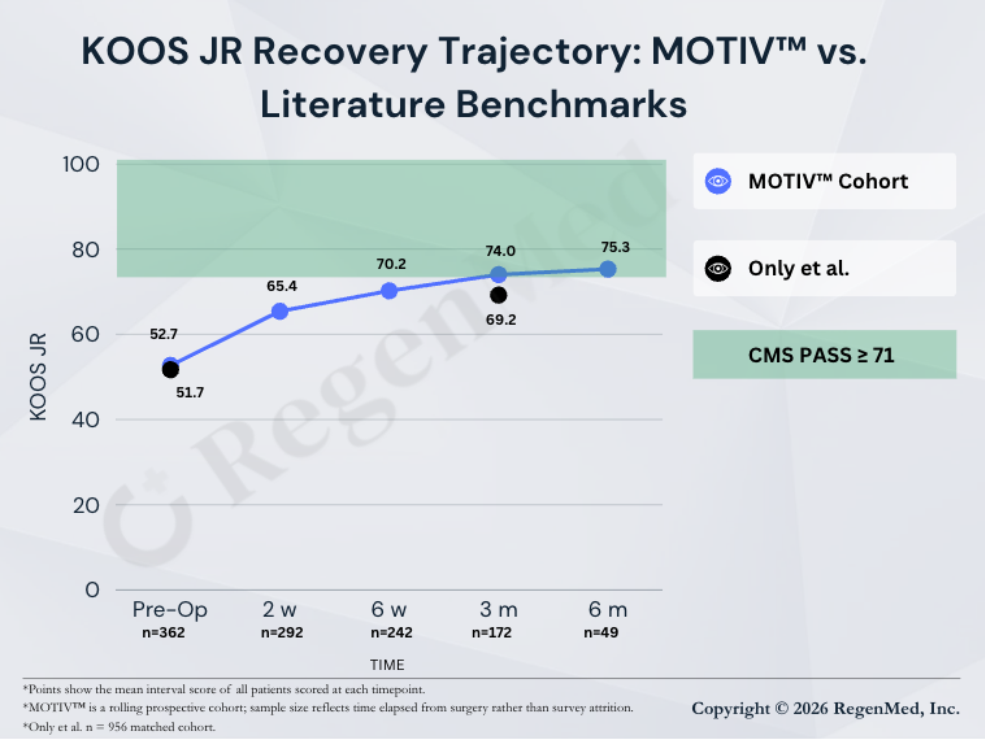
At baseline, the MOTIV™ cohort presents with severe functional joint impairment, characterized by a mean KOOS JR score of 52.7, aligning closely with baseline metrics established in academic cohorts (51.7)⁵ and statewide registry averages (50.0–53.0).¹ Following surgery, recovery accelerates rapidly: the cohort mean gains +12.7 points by 2 weeks (65.4) and +17.5 points by 6 weeks (70.2). By 3 months postoperatively, the cohort mean reaches 74.0 points, representing an aggregate functional gain of +21.3 points. This milestone clears the CMS 1-year Substantial Clinical Benefit threshold of ≥ 20 points while crossing the Patient Acceptable Symptom State cutoff (PASS ≥ 71) nine months ahead of conventional quality audit timelines.³
Methodological Comparison: Deconstructing the Literature
Benchmarking interim MOTIV™ metrics requires rigorous contextualization against the foundational clinical literature and multi-center registry datasets that govern orthopedic quality measurement.
Regulatory Origin: Lyman et al.
The regulatory baseline for modern arthroplasty quality measures was established by Lyman and colleagues in their landmark 2018 study of 1,940 primary TKA cases.³ Utilizing distribution-based calculations alongside anchor-based Receiver Operating Characteristic (ROC) modeling at 1 to 2 years postoperatively, the authors defined national clinical thresholds for the KOOS JR instrument: a Minimal Clinically Important Difference (MCID) of 14.0 points, a Substantial Clinical Benefit (SCB) of 20.0 points, and an absolute Patient Acceptable Symptom State (PASS) cutoff of 71.0 points.
CMS subsequently codified Lyman’s 20-point SCB standard as the patient-level success definition within the mandatory hospital-level PRO-PM measure, traditionally assessed between 10 and 14 months postoperatively.²˒³
While federal reporting examines this milestone at 1 year, the MOTIV™ cohort achieves an aggregate mean score improvement of +21.3 points by 3 months, entering an acceptable functional state (74.0) well in advance of historical expectations.
Intermediate Recovery Dynamics: Only et al.
To evaluate how functional improvement develops prior to 1-year end-states, Only and colleagues examined intermediate intervals within a matched academic cohort of 956 primary knee arthroplasties. Their findings proved that clinical benefit is dynamic rather than static: the anchor-based MCID escalated from 21.2 points at 3 months to 27.6 points at 1 year, reflecting response shift as acute perioperative symptoms resolve and patient lifestyle demands evolve. Within their cohort, mean KOOS JR scores progressed from 51.7 preoperatively to 69.2 at 3 months (+17.5 gain), ultimately reaching 76.3 at 1 year (+24.6 gain).⁵
Starting from an equivalent baseline (52.7 vs. 51.7), the MOTIV™ cohort reaches a 3-month mean score of 74.0 (+21.3 cohort difference). Whereas the Only et al. cohort remained below the acceptable symptom threshold at 3 months, MOTIV™ patients enter PASS (≥ 71) within the initial 90 days.
The 6-Month Functional Ceiling: Canfield et al.
The clinical utility of protracted quality follow-up was investigated by Canfield and co-authors across 1,120 primary total joint arthroplasties. Their analysis demonstrated that between 85% and 90% of total physical function and symptom gains occur within the initial 6 months postoperatively, after which functional score trajectories enter an asymptotic plateau. The authors concluded that routine 1- and 2-year survey mandates introduce substantial administrative burden and patient fatigue without reflecting meaningful changes in surgical efficacy.⁶
Longitudinal trends in the MOTIV™ cohort closely mirror this biological ceiling, progressing from 74.0 at 3 months to 75.3 at 6 months. These findings support MOTIV’s strategic emphasis on high-frequency acute capture (2 weeks, 6 weeks, and 3 months) to evaluate surgical techniques and recovery protocols while active tissue healing and functional restoration are occurring.
Statewide Real-World Benchmarking: MARCQI
Statewide registry performance from the Michigan Arthroplasty Registry Collaborative Quality Initiative (MARCQI), encompassing 87 participating surgical hospitals and independent centers, provides an extensive real-world comparator. Statewide trajectory curves published in MARCQI’s 2024 Annual Report illustrate a gradual 12-month recovery curve that levels out in the low-to-mid 70s.
However, collaborative-wide funnel plots reveal that only 53.3% of primary knee replacement patients across all 87 hospitals achieve the CMS 20-point improvement threshold at 1 year, falling short of the collaborative quality target of 60%. MARCQI further emphasized that patients entering surgery with baseline scores above 55 face a 24% risk of reporting functional deterioration or no perceived benefit due to ceiling effects.¹
In contrast to statewide 1-year attainment figures, the MOTIV™ cohort mean advances by +21.3 points at 3 months from an unadjusted baseline of 52.7, demonstrating strong functional acceleration ahead of formal matched-pair responder evaluations.
Protocol Adherence vs. Real-World Attrition: Mitigating the 25% APU Penalty
Under the CMS Hospital Inpatient Quality Reporting (IQR) framework, longitudinal PROM collection is directly coupled to institutional reimbursement. Inpatient Prospective Payment System (IPPS) hospitals failing to achieve complete pre- and postoperative matched PROM pairs on at least 50% of eligible primary elective THA/TKA procedures face a statutory 25% reduction in their annual Medicare Annual Payment Update (APU) market basket percentage increase.¹˒²
Despite extensive investment in electronic health record (EHR) patient portals and clinical staff outreach, meeting this 50% threshold remains an operational vulnerability across academic centers and regional quality collaboratives due to severe longitudinal patient attrition.¹˒⁷
The severity of real-world survey drop-off is illustrated in institutional analyses from high-volume academic centers. Sutton and colleagues evaluated survey completion within the Rothman Orthopaedic Institute registry under the Comprehensive Care for Joint Replacement (CJR) model. Although their Medicare cohort achieved 66.6% completion preoperatively, response rates deteriorated to 29.9% at 6 months and recovered to only 46.1% at the mandatory 1-year mark. Even within an optimized tertiary center utilizing automated patient portal prompts and clinic-based tablet workflows, routine clinical processes failed to clear the CMS 50% matched-pair threshold.⁷
These institutional findings are reinforced at the statewide level by MARCQI, which employs dedicated on-site hospital nurse abstractors across 87 participating facilities. For primary knee arthroplasties performed in early 2023, statewide 1-year PROM collection among eligible patients was limited to 42%. MARCQI explicitly identified 1-year follow-up capture as an enduring structural limitation, emphasizing that asymptomatic, successfully rehabilitated patients infrequently attend in-person 1-year clinical visits, precipitating severe survey dropout.¹
The MOTIV™ registry addresses this compliance failure through a differentiated patient engagement. By deploying automated survey workflows delivered via mobile SMS and secure web links directly into the patient’s daily environment, MOTIV™ bypasses the friction of patient portal registrations and in-office tablet collection. Enrollment is initiated during routine preoperative intake via a streamlined, two-minute digital workflow. Patients receive authenticated, tokenized survey links via SMS and email, eliminating portal logins while maintaining strict data governance.
While making registration easier is crucial, patient compliance is closely linked to the patient feeling rewarded for their time.
MOTIV™ eliminates the traditional “black box” nature of PROM collection by providing patients with immediate visibility into their personal longitudinal survey results. When patients can visualize their functional trajectory climbing from baseline across successive recovery intervals, the survey transforms from an extractive compliance chore into an engaging recovery tracking tool. This personal value exchange reinforces ongoing participation, allowing the MOTIV™ protocol to maintain 90% completion among eligible active patients through 6 months. In doing so, the protocol removes data-collection burdens from clinical staff while de-risking participating surgical facilities from the 25% APU penalty.
Methodological Rigor: Differences Between MOTIV™ RWE and Published Cohorts
Clear analysis of registry methodology and design is essential when benchmarking real-world evidence against published clinical trials and established quality databases. Several structural distinctions between the active MOTIV™ dataset and comparative literature cohorts warrant rigorous contextualization.
First, comparative studies such as Only et al. (n = 956) analyzed closed retrospective cohorts where all enrolled patients had complete, elapsed follow-up intervals. In contrast, MOTIV™ operates as a live, rolling prospective registry. Variations in sample size across intervals (from n = 362 preoperatively to n = 49 at 6 months) reflect chronological cohort maturation—the time elapsed since each patient’s index surgery—rather than patient attrition or study non-compliance.
Among patients who have reached eligible survey windows, active interval completion remains above 90%.
Second, interim registry dashboards and comparative figures report cross-sectional cohort score differences, calculated as the aggregate follow-up mean minus the baseline mean. While this approach accurately reflects population-level recovery velocity across timepoints, it does not represent individual within-subject change. In contrast, the CMS hospital PRO-PM measure and foundational clinical models evaluate patient-level responder rates, defined as the proportion of individual paired respondents achieving a calculated gain of 20 points or more. Formal within-subject paired responder analyses and risk-standardized regressions will be executed as locked longitudinal cohorts reach full 1-year maturity.
Finally, registry analyses must distinguish between relative improvement metrics and absolute functional states. The CMS 20-point Substantial Clinical Benefit threshold evaluates change from baseline.²˒³ However, as demonstrated in the MARCQI collaborative data, patients entering surgery with higher baseline functional scores encounter mathematical ceiling constraints where achieving a 20-point gain is restricted, despite achieving an optimal clinical outcome.¹
The Patient Acceptable Symptom State (PASS ≥ 71) serves as an independent, absolute benchmark of clinical success. The MOTIV™ cohort demonstrates robust performance across both dimensions: achieving an aggregate cohort gain of +21.3 points while concurrently surpassing the absolute PASS threshold with an average score of 74.0 by 3 months postoperatively.³
Clinical Inquiry & Next Operational Steps
The interim functional acceleration observed across the active MOTIV™ cohort demonstrates that early recovery plateaus can be achieved substantially ahead of historical 12-month registry benchmarks. However, these compelling interim trajectories require disciplined clinical interrogation: we do not yet conclude which specific combination of surgical, anesthetic, and postoperative variables drives this early functional velocity.
The core mission of the MOTIV™ collaborative is to transform prospective real-world data into actionable clinical intelligence:
- Multimodal Protocol Isolation: Collaborative investigators are actively evaluating the interplay between non-opioid multimodal analgesia pathways, kinematic vs. mechanical alignment techniques, outpatient discharge timing, and early physical rehabilitation strategies to isolate the primary determinants of acute KOOS JR gain.
- Physician Data Sovereignty: In contrast to legacy commercial registries, participating MOTIV™ investigators retain complete ownership of their prospective datasets, allowing surgical practices to benchmark their institutional outcomes against aggregate national curves while preserving full academic publishing rights.
- Preparation for Matched Longitudinal Publications: As active prospective cohorts reach 12-month follow-up, RegenMed and the OREF clinical working group will execute locked within-subject paired responder analyses (n ≥ 250), stratifying outcomes by baseline deformity, medical comorbidities, and specific perioperative protocols for peer-reviewed journal submission.
References
- Michigan Arthroplasty Registry Collaborative Quality Initiative (MARCQI). 2024 Annual Report (Comprehensive Version). Chapter 1: Quality Improvement Update, Section 1.1: Patient Reported Outcomes (PROs), pp. 1–3; Site Listing, p. ii (87 sites). Published December 2024. 2024 MARCQI Annual Report
- Centers for Medicare & Medicaid Services (CMS). Hospital Inpatient Quality Reporting (IQR) Program: Measure Technical Specifications for the Hospital-Level Total Hip and/or Total Knee Arthroplasty (THA/TKA) Patient-Reported Outcome-Based Performance Measure (PRO-PM). CMS.gov.
- Lyman S, Lee YY, Franklin PD, Li W, Mayman DJ, Marx RG. What Are the Minimal and Substantial Improvements in the HOOS and KOOS and JR Versions After Total Joint Replacement? Clin Orthop Relat Res. 2018;476(12):2432–2441. PubMed: 30179951.
- Mercuri J and Wickline A. MOTIV™ and the Next Frontier of Orthopaedic Evidence Generation: A New Model for Physician-Led Clinical Research. J Orthop Experience & Innovation. 2026. Article
- Only AJ, et al. Interpreting the Knee Osteoarthritis Outcome Score Joint Replacement Minimum Clinically Important Difference Values Vary Over Time Within the Same Patient Cohort. J Orthop Experience & Innovation. 2021. Article
- Canfield M, Savoy L, Cote MP, Halawi MJ. Patient-Reported Outcome Measures in Total Joint Arthroplasty: Defining the Optimal Collection Window. Arthroplasty Today. 2020;6(1):62–67. PMID: 32211477.
- Sutton RM, Baker CM, D’Amore T, Courtney PM, Krueger CA, Austin MS. Poor Patient Compliance Limits the Attainability of Patient-Reported Outcome Measure Completion Thresholds for the Comprehensive Care for Joint Arthroplasty Model. J Arthroplasty. 2023;38(7 Suppl 2)–S68. PMID: 37343281.
- RegenMed. White Paper: Circles Platform for CJR-X: What It Costs to Get It Wrong. Published September 16, 2026. White Paper
- RegenMed. White Paper: Underwriting the Episode of Care: The CMS-Mandated Transition to Hospital-Managed Actuarial Risk. Published August 14, 2026. White Paper


MOTIV™ TKA Circle Encouraging Emerging Trends
October 29, 2026
Executive Summary & Clinical Rationale
As value-based reimbursement models mature, the Centers for Medicare & Medicaid Services (CMS) has codified longitudinal functional tracking directly into hospital payment determinations through the Hospital-Level Patient-Reported Outcome-Based Performance Measure (PRO-PM) for Primary Total Hip and Total Knee Arthroplasty (THA/TKA). Under the CMS Inpatient Quality Reporting (IQR) framework, surgical practices and health systems face dual operational challenges.
First, institutions must secure paired pre- and postoperative PROM collections across at least 50% of eligible cases to avert a statutory 25% reduction in their annual Medicare Annual Payment Update (APU) market basket percentage increase.¹˒² Second, facilities must meet risk-standardized improvement thresholds that evaluate whether individual patients achieve a Substantial Clinical Benefit (SCB), defined nationally as a 20-point or greater improvement on the Knee injury and Osteoarthritis Outcome Score for Joint Replacement (KOOS JR).³
These quality mandates carry heightened urgency under the finalized Comprehensive Care for Joint Replacement Expanded (CJR-X) model, taking effect nationwide on January 1, 2028 across approximately 2,500 acute care hospitals. Under CJR-X, CMS transitions standard facilities into localized risk-bearing payers, mandating two-sided actuarial accountability across a 90-day cross-continuum episode encompassing inpatient surgery, professional fees, and post-acute utilization.
Crucially, the model weaponizes the Composite Quality Score (CQS) as an absolute financial gatekeeper: failing to meet required PROM survey capture thresholds or clinical improvement targets forfeits a hospital’s entire reconciliation payment, transferring all downside financial liability directly onto the institution’s balance sheet regardless of realized procedural savings.⁸˒⁹
Historically, large-scale national registries (such as the American Joint Replacement Registry) have aligned PROM collection almost exclusively with CMS reporting windows, capturing outcomes preoperatively and between 10 and 14 months (300–425 days) postoperatively.¹˒² While this timeline evaluates final arthroplasty end-states, it leaves early functional recovery—specifically the acute 2-week, 6-week, and 3-month intervals—largely uncharacterized in multi-center datasets. Furthermore, relying entirely on a 1-year survey window introduces substantial patient attrition, as recovered patients routinely disengage from clinical follow-up.¹˒⁷
The MOTIV™ Wickline/Mercuri TKA Circle—a product-agnostic, real-world evidence (RWE) initiative established in collaboration with the Orthopaedic Research and Education Foundation (OREF) and co-designed by Drs. Andrew Wickline and John Mercuri—addresses these longitudinal limitations.⁴ By pairing standardized clinical pathways with automated, direct-to-patient digital workflows, MOTIV™ captures high-frequency functional recovery across 2 weeks, 6 weeks, 3 months, 6 months, and 1 year postoperatively while sustaining exceptionally high cohort adherence. This briefing evaluates interim KOOS JR trajectories and compliance benchmarks from the actively enrolling MOTIV™ cohort against landmark validation literature and multi-center registry standards.
MOTIV™ Interim Cohort Recovery Profile
The active MOTIV™ registry evaluates a prospective, rolling real-world evidence (RWE) cohort of patients undergoing primary elective total knee arthroplasty across participating centers. Because enrollment is continuous and ongoing, cohort sizes at later postoperative intervals reflect the chronological maturation of enrolled cases rather than patient attrition; across all active intervals, survey compliance among eligible patients exceeds 90%.
As of October 2026, interim unadjusted KOOS JR scores demonstrate rapid functional velocity, with patients achieving benchmark functional thresholds within the initial 90 days of recovery (Table 1).
At baseline, the MOTIV™ cohort presents with severe functional joint impairment, characterized by a mean KOOS JR score of 52.7, aligning closely with baseline metrics established in academic cohorts (51.7)⁵ and statewide registry averages (50.0–53.0).¹ Following surgery, recovery accelerates rapidly: the cohort mean gains +12.7 points by 2 weeks (65.4) and +17.5 points by 6 weeks (70.2). By 3 months postoperatively, the cohort mean reaches 74.0 points, representing an aggregate functional gain of +21.3 points. This milestone clears the CMS 1-year Substantial Clinical Benefit threshold of ≥ 20 points while crossing the Patient Acceptable Symptom State cutoff (PASS ≥ 71) nine months ahead of conventional quality audit timelines.³
Methodological Comparison: Deconstructing the Literature
Benchmarking interim MOTIV™ metrics requires rigorous contextualization against the foundational clinical literature and multi-center registry datasets that govern orthopedic quality measurement.
Regulatory Origin: Lyman et al.
The regulatory baseline for modern arthroplasty quality measures was established by Lyman and colleagues in their landmark 2018 study of 1,940 primary TKA cases.³ Utilizing distribution-based calculations alongside anchor-based Receiver Operating Characteristic (ROC) modeling at 1 to 2 years postoperatively, the authors defined national clinical thresholds for the KOOS JR instrument: a Minimal Clinically Important Difference (MCID) of 14.0 points, a Substantial Clinical Benefit (SCB) of 20.0 points, and an absolute Patient Acceptable Symptom State (PASS) cutoff of 71.0 points.
CMS subsequently codified Lyman’s 20-point SCB standard as the patient-level success definition within the mandatory hospital-level PRO-PM measure, traditionally assessed between 10 and 14 months postoperatively.²˒³
While federal reporting examines this milestone at 1 year, the MOTIV™ cohort achieves an aggregate mean score improvement of +21.3 points by 3 months, entering an acceptable functional state (74.0) well in advance of historical expectations.
Intermediate Recovery Dynamics: Only et al.
To evaluate how functional improvement develops prior to 1-year end-states, Only and colleagues examined intermediate intervals within a matched academic cohort of 956 primary knee arthroplasties. Their findings proved that clinical benefit is dynamic rather than static: the anchor-based MCID escalated from 21.2 points at 3 months to 27.6 points at 1 year, reflecting response shift as acute perioperative symptoms resolve and patient lifestyle demands evolve. Within their cohort, mean KOOS JR scores progressed from 51.7 preoperatively to 69.2 at 3 months (+17.5 gain), ultimately reaching 76.3 at 1 year (+24.6 gain).⁵
Starting from an equivalent baseline (52.7 vs. 51.7), the MOTIV™ cohort reaches a 3-month mean score of 74.0 (+21.3 cohort difference). Whereas the Only et al. cohort remained below the acceptable symptom threshold at 3 months, MOTIV™ patients enter PASS (≥ 71) within the initial 90 days.
The 6-Month Functional Ceiling: Canfield et al.
The clinical utility of protracted quality follow-up was investigated by Canfield and co-authors across 1,120 primary total joint arthroplasties. Their analysis demonstrated that between 85% and 90% of total physical function and symptom gains occur within the initial 6 months postoperatively, after which functional score trajectories enter an asymptotic plateau. The authors concluded that routine 1- and 2-year survey mandates introduce substantial administrative burden and patient fatigue without reflecting meaningful changes in surgical efficacy.⁶
Longitudinal trends in the MOTIV™ cohort closely mirror this biological ceiling, progressing from 74.0 at 3 months to 75.3 at 6 months. These findings support MOTIV’s strategic emphasis on high-frequency acute capture (2 weeks, 6 weeks, and 3 months) to evaluate surgical techniques and recovery protocols while active tissue healing and functional restoration are occurring.
Statewide Real-World Benchmarking: MARCQI
Statewide registry performance from the Michigan Arthroplasty Registry Collaborative Quality Initiative (MARCQI), encompassing 87 participating surgical hospitals and independent centers, provides an extensive real-world comparator. Statewide trajectory curves published in MARCQI’s 2024 Annual Report illustrate a gradual 12-month recovery curve that levels out in the low-to-mid 70s.
However, collaborative-wide funnel plots reveal that only 53.3% of primary knee replacement patients across all 87 hospitals achieve the CMS 20-point improvement threshold at 1 year, falling short of the collaborative quality target of 60%. MARCQI further emphasized that patients entering surgery with baseline scores above 55 face a 24% risk of reporting functional deterioration or no perceived benefit due to ceiling effects.¹
In contrast to statewide 1-year attainment figures, the MOTIV™ cohort mean advances by +21.3 points at 3 months from an unadjusted baseline of 52.7, demonstrating strong functional acceleration ahead of formal matched-pair responder evaluations.
Protocol Adherence vs. Real-World Attrition: Mitigating the 25% APU Penalty
Under the CMS Hospital Inpatient Quality Reporting (IQR) framework, longitudinal PROM collection is directly coupled to institutional reimbursement. Inpatient Prospective Payment System (IPPS) hospitals failing to achieve complete pre- and postoperative matched PROM pairs on at least 50% of eligible primary elective THA/TKA procedures face a statutory 25% reduction in their annual Medicare Annual Payment Update (APU) market basket percentage increase.¹˒²
Despite extensive investment in electronic health record (EHR) patient portals and clinical staff outreach, meeting this 50% threshold remains an operational vulnerability across academic centers and regional quality collaboratives due to severe longitudinal patient attrition.¹˒⁷
The severity of real-world survey drop-off is illustrated in institutional analyses from high-volume academic centers. Sutton and colleagues evaluated survey completion within the Rothman Orthopaedic Institute registry under the Comprehensive Care for Joint Replacement (CJR) model. Although their Medicare cohort achieved 66.6% completion preoperatively, response rates deteriorated to 29.9% at 6 months and recovered to only 46.1% at the mandatory 1-year mark. Even within an optimized tertiary center utilizing automated patient portal prompts and clinic-based tablet workflows, routine clinical processes failed to clear the CMS 50% matched-pair threshold.⁷
These institutional findings are reinforced at the statewide level by MARCQI, which employs dedicated on-site hospital nurse abstractors across 87 participating facilities. For primary knee arthroplasties performed in early 2023, statewide 1-year PROM collection among eligible patients was limited to 42%. MARCQI explicitly identified 1-year follow-up capture as an enduring structural limitation, emphasizing that asymptomatic, successfully rehabilitated patients infrequently attend in-person 1-year clinical visits, precipitating severe survey dropout.¹
The MOTIV™ registry addresses this compliance failure through a differentiated patient engagement. By deploying automated survey workflows delivered via mobile SMS and secure web links directly into the patient’s daily environment, MOTIV™ bypasses the friction of patient portal registrations and in-office tablet collection. Enrollment is initiated during routine preoperative intake via a streamlined, two-minute digital workflow. Patients receive authenticated, tokenized survey links via SMS and email, eliminating portal logins while maintaining strict data governance.
While making registration easier is crucial, patient compliance is closely linked to the patient feeling rewarded for their time.
MOTIV™ eliminates the traditional “black box” nature of PROM collection by providing patients with immediate visibility into their personal longitudinal survey results. When patients can visualize their functional trajectory climbing from baseline across successive recovery intervals, the survey transforms from an extractive compliance chore into an engaging recovery tracking tool. This personal value exchange reinforces ongoing participation, allowing the MOTIV™ protocol to maintain 90% completion among eligible active patients through 6 months. In doing so, the protocol removes data-collection burdens from clinical staff while de-risking participating surgical facilities from the 25% APU penalty.
Methodological Rigor: Differences Between MOTIV™ RWE and Published Cohorts
Clear analysis of registry methodology and design is essential when benchmarking real-world evidence against published clinical trials and established quality databases. Several structural distinctions between the active MOTIV™ dataset and comparative literature cohorts warrant rigorous contextualization.
First, comparative studies such as Only et al. (n = 956) analyzed closed retrospective cohorts where all enrolled patients had complete, elapsed follow-up intervals. In contrast, MOTIV™ operates as a live, rolling prospective registry. Variations in sample size across intervals (from n = 362 preoperatively to n = 49 at 6 months) reflect chronological cohort maturation—the time elapsed since each patient’s index surgery—rather than patient attrition or study non-compliance.
Among patients who have reached eligible survey windows, active interval completion remains above 90%.
Second, interim registry dashboards and comparative figures report cross-sectional cohort score differences, calculated as the aggregate follow-up mean minus the baseline mean. While this approach accurately reflects population-level recovery velocity across timepoints, it does not represent individual within-subject change. In contrast, the CMS hospital PRO-PM measure and foundational clinical models evaluate patient-level responder rates, defined as the proportion of individual paired respondents achieving a calculated gain of 20 points or more. Formal within-subject paired responder analyses and risk-standardized regressions will be executed as locked longitudinal cohorts reach full 1-year maturity.
Finally, registry analyses must distinguish between relative improvement metrics and absolute functional states. The CMS 20-point Substantial Clinical Benefit threshold evaluates change from baseline.²˒³ However, as demonstrated in the MARCQI collaborative data, patients entering surgery with higher baseline functional scores encounter mathematical ceiling constraints where achieving a 20-point gain is restricted, despite achieving an optimal clinical outcome.¹
The Patient Acceptable Symptom State (PASS ≥ 71) serves as an independent, absolute benchmark of clinical success. The MOTIV™ cohort demonstrates robust performance across both dimensions: achieving an aggregate cohort gain of +21.3 points while concurrently surpassing the absolute PASS threshold with an average score of 74.0 by 3 months postoperatively.³
Clinical Inquiry & Next Operational Steps
The interim functional acceleration observed across the active MOTIV™ cohort demonstrates that early recovery plateaus can be achieved substantially ahead of historical 12-month registry benchmarks. However, these compelling interim trajectories require disciplined clinical interrogation: we do not yet conclude which specific combination of surgical, anesthetic, and postoperative variables drives this early functional velocity.
The core mission of the MOTIV™ collaborative is to transform prospective real-world data into actionable clinical intelligence:
- Multimodal Protocol Isolation: Collaborative investigators are actively evaluating the interplay between non-opioid multimodal analgesia pathways, kinematic vs. mechanical alignment techniques, outpatient discharge timing, and early physical rehabilitation strategies to isolate the primary determinants of acute KOOS JR gain.
- Physician Data Sovereignty: In contrast to legacy commercial registries, participating MOTIV™ investigators retain complete ownership of their prospective datasets, allowing surgical practices to benchmark their institutional outcomes against aggregate national curves while preserving full academic publishing rights.
- Preparation for Matched Longitudinal Publications: As active prospective cohorts reach 12-month follow-up, RegenMed and the OREF clinical working group will execute locked within-subject paired responder analyses (n ≥ 250), stratifying outcomes by baseline deformity, medical comorbidities, and specific perioperative protocols for peer-reviewed journal submission.
References
- Michigan Arthroplasty Registry Collaborative Quality Initiative (MARCQI). 2024 Annual Report (Comprehensive Version). Chapter 1: Quality Improvement Update, Section 1.1: Patient Reported Outcomes (PROs), pp. 1–3; Site Listing, p. ii (87 sites). Published December 2024. 2024 MARCQI Annual Report
- Centers for Medicare & Medicaid Services (CMS). Hospital Inpatient Quality Reporting (IQR) Program: Measure Technical Specifications for the Hospital-Level Total Hip and/or Total Knee Arthroplasty (THA/TKA) Patient-Reported Outcome-Based Performance Measure (PRO-PM). CMS.gov.
- Lyman S, Lee YY, Franklin PD, Li W, Mayman DJ, Marx RG. What Are the Minimal and Substantial Improvements in the HOOS and KOOS and JR Versions After Total Joint Replacement? Clin Orthop Relat Res. 2018;476(12):2432–2441. PubMed: 30179951.
- Mercuri J and Wickline A. MOTIV™ and the Next Frontier of Orthopaedic Evidence Generation: A New Model for Physician-Led Clinical Research. J Orthop Experience & Innovation. 2026. Article
- Only AJ, et al. Interpreting the Knee Osteoarthritis Outcome Score Joint Replacement Minimum Clinically Important Difference Values Vary Over Time Within the Same Patient Cohort. J Orthop Experience & Innovation. 2021. Article
- Canfield M, Savoy L, Cote MP, Halawi MJ. Patient-Reported Outcome Measures in Total Joint Arthroplasty: Defining the Optimal Collection Window. Arthroplasty Today. 2020;6(1):62–67. PMID: 32211477.
- Sutton RM, Baker CM, D’Amore T, Courtney PM, Krueger CA, Austin MS. Poor Patient Compliance Limits the Attainability of Patient-Reported Outcome Measure Completion Thresholds for the Comprehensive Care for Joint Arthroplasty Model. J Arthroplasty. 2023;38(7 Suppl 2)–S68. PMID: 37343281.
- RegenMed. White Paper: Circles Platform for CJR-X: What It Costs to Get It Wrong. Published September 16, 2026. White Paper
- RegenMed. White Paper: Underwriting the Episode of Care: The CMS-Mandated Transition to Hospital-Managed Actuarial Risk. Published August 14, 2026. White Paper
