
Evaluating Real-World Outcomes: InternalBrace™ Augmentation vs. Standard ACL Reconstruction Standards
August 20, 2026


Evaluating Real-World Outcomes: InternalBrace™ Augmentation vs. Standard ACL Reconstruction Standards
Real-world evidence (RWE) plays a crucial role in validating surgical techniques and implant technologies beyond controlled trial settings. Today, we are taking a closer look at patient-reported outcomes—specifically the KOOS Quality of Life (QoL) subscale—from Dr. Gordon Mackay’s Knee Registry and benchmarking them against established national registry standards.
Values presented for Dr. Mackay’s registry represent the calculated averages of all available survey responses within the cohort at each respective timepoint.
Dr. Mackay’s registry contains approximately 818 populated cases utilizing the InternalBrace™ across various knee procedures (including complex multi-ligament, cartilage, and meniscal repairs), we narrowed our analysis to ensure a direct, methodologically sound comparison. To create a clean, "apples-to-apples" benchmark against standard ACL reconstruction (ACLR) literature, we excluded multi-procedure combination cases and focused strictly on InternalBrace™ procedures where isolated ACL reconstruction was the primary associated procedure.
- InternalBrace™ ACL Cohort (n = 164): Isolated ACL reconstruction augmented with InternalBrace™.
- Control Benchmark (n = 7,331): Standard, unaugmented primary ACL reconstruction data drawn directly from the Sweden Cohort within the Scandinavian Knee Ligament Registry (Granan et al.).
We selected the Sweden dataset from the Scandinavian registry because it represents the largest, most complete single-country dataset with standardized KOOS reporting across baseline (pre-op), 1-year, and 2-year follow-up intervals.
When comparing real-world populations, patient demographics tell an important story:
- Sweden Control Cohort: Median Age 25 (Range: 8–67)
- Dr. Mackay InternalBrace™ Cohort: Median Age 47 (Range: 13–71)
Despite Dr. Mackay’s cohort representing a significantly older patient demographic, who typically present with higher rates of pre-existing joint wear, the InternalBrace™ group demonstrated accelerated recovery and superior long-term functional quality of life.
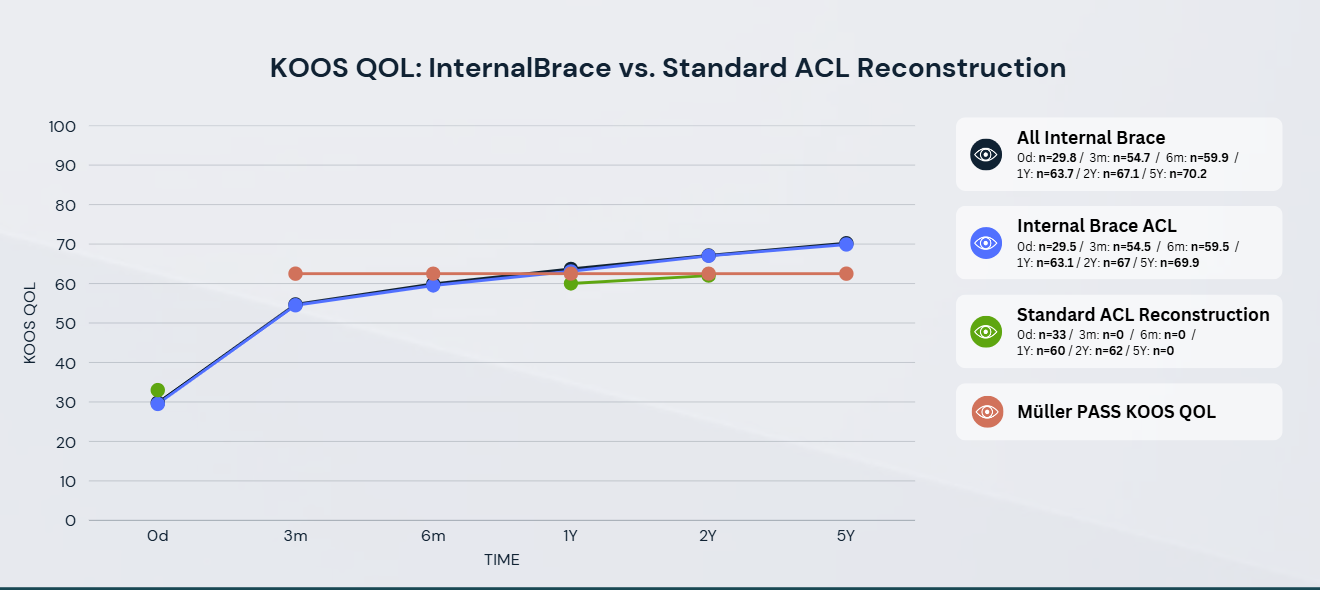
Traditional national registries typically capture outcomes at 0D (Baseline), 1 Year, and 2 Years. However, relying solely on annual intervals leaves a critical blind spot during the most dynamic phase of patient rehabilitation: the first 6 months.
As shown in Graph 1, frequent early-timepoint tracking (3 Months and 6 Months) reveals the true sensitivity of patient recovery:
- At 3 Months (90D) post-op, the InternalBrace™ ACL cohort already achieves a KOOS QoL score of 54.5, reaching 59.5 by 6 Months.
- By 1 Year (365D), the InternalBrace™ cohort crosses the established Müller PASS (Patient Acceptable Symptom State) threshold of 62.5 points with a score of 63.1, climbing to 67.0 at 2 Years and reaching 69.9 at 5 Years.
Collecting frequent, granular data in the early post-operative period gives clinicians and device manufacturers a far more sensitive understanding of recovery trajectories, return-to-play readiness, and early intervention needs.
When we overlay Dr. Mackay's cohort directly onto the traditional timeline used by the Sweden registry (Baseline, 1 Year, 2 Years), the trajectory difference remains clear.
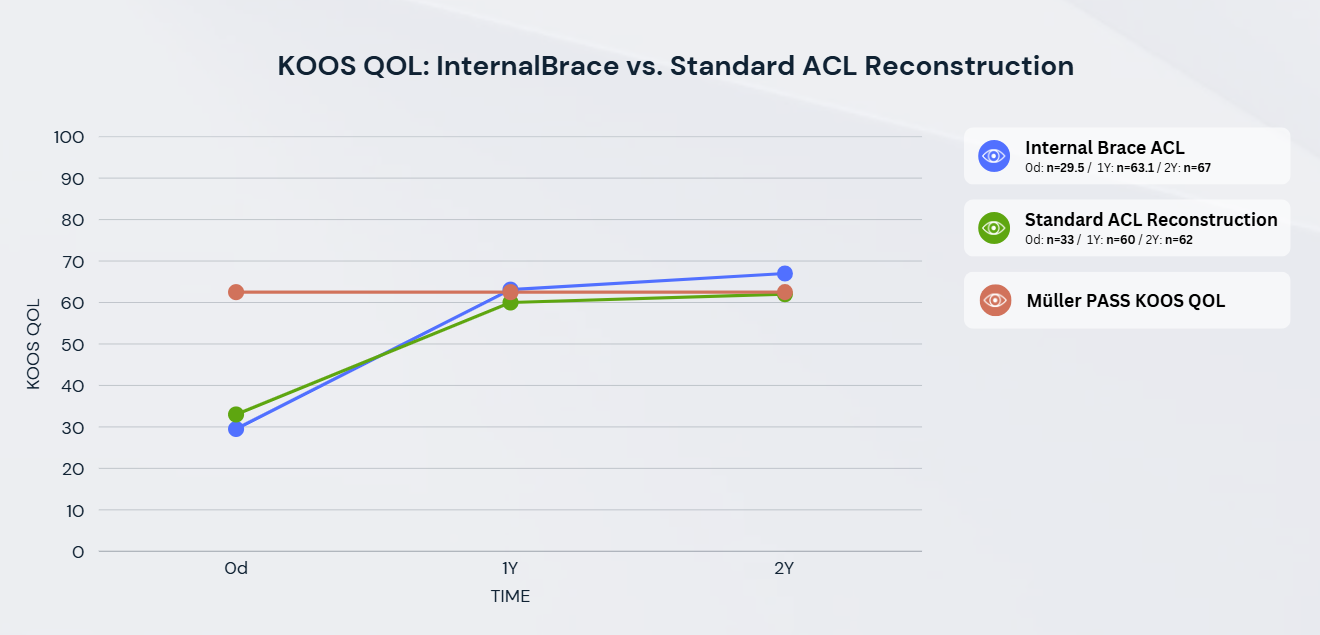
- Baseline (0D): Both groups start at an equivalent level of functional impairment (29.5 for InternalBrace™ vs. 33.0 for Sweden).
- 1 Year: InternalBrace™ ACL reaches 63.1, surpassing the Sweden national average of 60.0.
- 2 Years: InternalBrace™ ACL extends its advantage to 67.0 versus Sweden’s 62.0.
Notably, the InternalBrace™ cohort comfortably surpasses the Müller PASS threshold (62.5 points) by Year 1, whereas the standard ACL reconstruction average hovers near the threshold at Year 2.
While these observational findings demonstrate clear clinical promise, expanding real-world registry tracking remains essential to achieving greater statistical power, refining age-matched subgroup controls, and delivering definitive insights for modern orthopedic care.
Are you interested in evaluating how your surgical protocols, medical devices, or biologic therapies perform in the real world? Partnering with an independent real-world data registry allows orthopedic manufacturers, surgical groups, and clinical leaders to unlock actionable outcome analytics, accelerate commercial adoption, and prove clinical value. Connect with our team today to learn how you can license existing real-world datasets or build a custom observational registry for your technology.
Data Sources & References:
- Scandinavian Knee Ligament Registry Benchmark: Granan RL, Bahr R, Steindal K, Furnes O, Engebretsen L. Development of a national ACL registry in Norway.
- Read the Study Müller PASS Threshold Benchmark (62.5 points): Müller B, Yabroudi MA, Lynch A, et al. Defining Thresholds for the Patient Acceptable Symptom State for the IKDC Subjective Knee Form and KOOS for Patients Who Underwent ACL Reconstruction. Am J Sports Med. 2016


Evaluating Real-World Outcomes: InternalBrace™ Augmentation vs. Standard ACL Reconstruction Standards
August 20, 2026
Real-world evidence (RWE) plays a crucial role in validating surgical techniques and implant technologies beyond controlled trial settings. Today, we are taking a closer look at patient-reported outcomes—specifically the KOOS Quality of Life (QoL) subscale—from Dr. Gordon Mackay’s Knee Registry and benchmarking them against established national registry standards.
Values presented for Dr. Mackay’s registry represent the calculated averages of all available survey responses within the cohort at each respective timepoint.
Dr. Mackay’s registry contains approximately 818 populated cases utilizing the InternalBrace™ across various knee procedures (including complex multi-ligament, cartilage, and meniscal repairs), we narrowed our analysis to ensure a direct, methodologically sound comparison. To create a clean, "apples-to-apples" benchmark against standard ACL reconstruction (ACLR) literature, we excluded multi-procedure combination cases and focused strictly on InternalBrace™ procedures where isolated ACL reconstruction was the primary associated procedure.
- InternalBrace™ ACL Cohort (n = 164): Isolated ACL reconstruction augmented with InternalBrace™.
- Control Benchmark (n = 7,331): Standard, unaugmented primary ACL reconstruction data drawn directly from the Sweden Cohort within the Scandinavian Knee Ligament Registry (Granan et al.).
We selected the Sweden dataset from the Scandinavian registry because it represents the largest, most complete single-country dataset with standardized KOOS reporting across baseline (pre-op), 1-year, and 2-year follow-up intervals.
When comparing real-world populations, patient demographics tell an important story:
- Sweden Control Cohort: Median Age 25 (Range: 8–67)
- Dr. Mackay InternalBrace™ Cohort: Median Age 47 (Range: 13–71)
Despite Dr. Mackay’s cohort representing a significantly older patient demographic, who typically present with higher rates of pre-existing joint wear, the InternalBrace™ group demonstrated accelerated recovery and superior long-term functional quality of life.
Traditional national registries typically capture outcomes at 0D (Baseline), 1 Year, and 2 Years. However, relying solely on annual intervals leaves a critical blind spot during the most dynamic phase of patient rehabilitation: the first 6 months.
As shown in Graph 1, frequent early-timepoint tracking (3 Months and 6 Months) reveals the true sensitivity of patient recovery:
- At 3 Months (90D) post-op, the InternalBrace™ ACL cohort already achieves a KOOS QoL score of 54.5, reaching 59.5 by 6 Months.
- By 1 Year (365D), the InternalBrace™ cohort crosses the established Müller PASS (Patient Acceptable Symptom State) threshold of 62.5 points with a score of 63.1, climbing to 67.0 at 2 Years and reaching 69.9 at 5 Years.
Collecting frequent, granular data in the early post-operative period gives clinicians and device manufacturers a far more sensitive understanding of recovery trajectories, return-to-play readiness, and early intervention needs.
When we overlay Dr. Mackay's cohort directly onto the traditional timeline used by the Sweden registry (Baseline, 1 Year, 2 Years), the trajectory difference remains clear.
- Baseline (0D): Both groups start at an equivalent level of functional impairment (29.5 for InternalBrace™ vs. 33.0 for Sweden).
- 1 Year: InternalBrace™ ACL reaches 63.1, surpassing the Sweden national average of 60.0.
- 2 Years: InternalBrace™ ACL extends its advantage to 67.0 versus Sweden’s 62.0.
Notably, the InternalBrace™ cohort comfortably surpasses the Müller PASS threshold (62.5 points) by Year 1, whereas the standard ACL reconstruction average hovers near the threshold at Year 2.
While these observational findings demonstrate clear clinical promise, expanding real-world registry tracking remains essential to achieving greater statistical power, refining age-matched subgroup controls, and delivering definitive insights for modern orthopedic care.
Are you interested in evaluating how your surgical protocols, medical devices, or biologic therapies perform in the real world? Partnering with an independent real-world data registry allows orthopedic manufacturers, surgical groups, and clinical leaders to unlock actionable outcome analytics, accelerate commercial adoption, and prove clinical value. Connect with our team today to learn how you can license existing real-world datasets or build a custom observational registry for your technology.
Data Sources & References:
- Scandinavian Knee Ligament Registry Benchmark: Granan RL, Bahr R, Steindal K, Furnes O, Engebretsen L. Development of a national ACL registry in Norway.
- Read the Study Müller PASS Threshold Benchmark (62.5 points): Müller B, Yabroudi MA, Lynch A, et al. Defining Thresholds for the Patient Acceptable Symptom State for the IKDC Subjective Knee Form and KOOS for Patients Who Underwent ACL Reconstruction. Am J Sports Med. 2016
